#Hand-Altered-Film
- Technique where filmmaker physically alters the film on which the work was recorded; May involve painting, scratching, or bleaching directly on film.
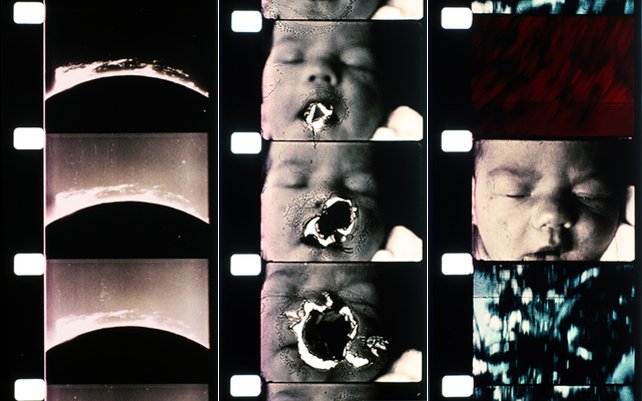
Image Courtesy of IMDb
“Most of [Stan Brakhage’s] late work was composed of hand-painted films, the dyes of which are suspected to have eventually killed him.”
(Starnes, “Stan Brakhage,” The Brooklyn Rail)
#Superimposition/Layering
- Technique where one or more images are placed on top of one another in a frame to produce meaning
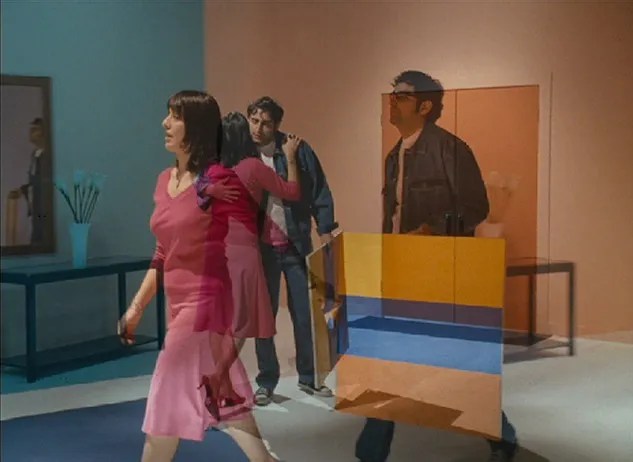
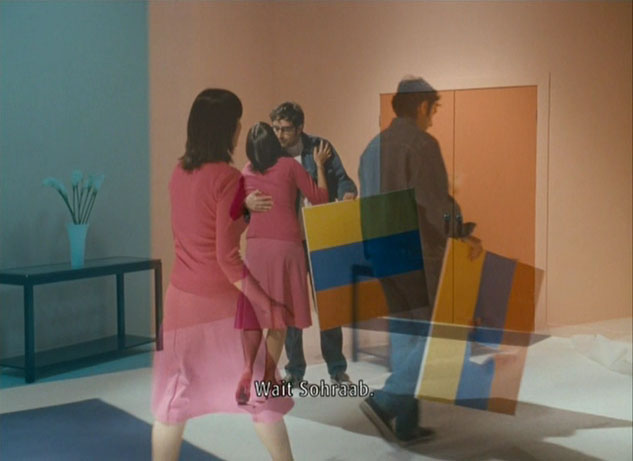
Images Courtesy of Lightcone and Deeper into Movies
“‘SSHTOORRTY’ is the image of a staged event which has been divided into 2 halves each superimposed (sound and picture) one on top of the other. The title is the word SHORT superimposed on the word STORY. It’s a “painting” about a painting in which Before and After become a Transparent Now. Arrival and Departure are unified.” (CONE)
#Found-Footage/Appropriation
- Involves a re-editing of existing materials including newsreels, advertisements, or Hollywood clips
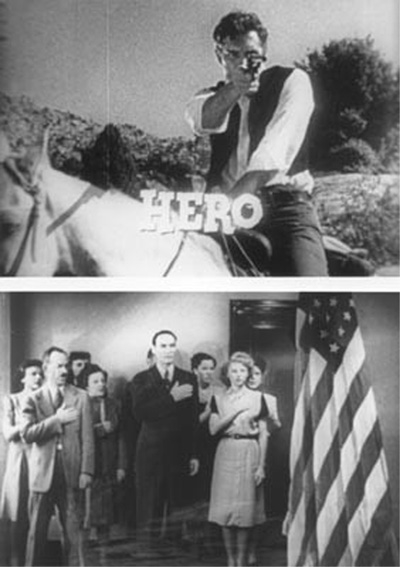
Image Courtesy of Euro Mediterranean Arts
“America Is Waiting, 1981, like Conner’s earlier films, is a compilation, a wacky assortment of bits and pieces of old newsreels, educational films, Hollywood movies, ’50s TV commercials, and hermetic fragments of industrial “film features” that one remembers dotting the devotional desert of Sunday morning programming long ago. Conner’s films are resurrections of sorts (film and photography are perhaps the ultimate forms of mummification) and, like most resurrections, there is something about them that is both ghoulish and uncanny […] Though it would be simplistic and even wrong to push the analogy too far, both collages and compilation films bring disparate elements together within a common field, destroying or using context to produce new, unforeseen combinations. The new unity elaborated by associative links presupposes the varying origins of individual elements and the viewer’s memory of their former, more familiar, context. (Cook, “The Uncanny Resurrection,” Artforum)
#Flickering/Strobing
- “characterized as rapid bright flashing light” (Centre for Screen Cultures)

Image Courtesy of Twitter
“Ito Takashi’s second period, which begins with the short film Thunder (1982), adds many of these elements to the experiments of the first: light painting, superimpositions, mystical demons, ghostly voices. Although the number of techniques employed is multiplied, the principle resembles that of his previous films. Thunder is limited to a single space (what seems to be a university building), and a single gesture (the ghostly image of a woman veering and uncovering her face), and through a mathematical and arbitrary series of possibilities the film builds up expectations, disappointing them, bringing them to paroxysm and surprise each time the viewer believes the film has exhausted its systemic possibilities. A gesture of shame, of timidity thus inhabits a building like an monomaniacal ghost projected upon its walls, captured in a photograph, re-animated through stop motion, granted a half-life between the perceptible world and the imagined one.”
#Abstraction/Non-Representational-Imagery
- Filmmaker uses shapes, colors, or textures as stand-ins for more recognizable objects
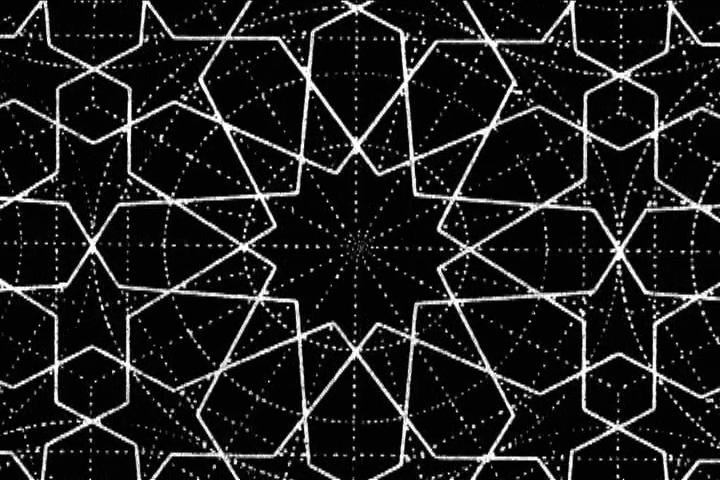
Image Courtesy of Usama Alshaibi
“Rhythm and repetition plays an important role in the animated film Allahu Akbar by Usama Alshaibi. With this film, Alshaibi questions the confrontation between tradition and modernity by drawing inspiration from geometric motives of Islamic art. The artist offers a re-interpretation of these motifs through computer animation. By turning the shapes in different direction, new images are generated, freeing them from their fixed state. Traditional spiritual values feed the present and open up to a modern perspective.” (TMDB)
 avant-garde film index