Introduction
Early on, as an undergraduate at the University of Michigan, I discovered the immense role the avant gardes played in cinema’s development. I still remember the first day of my “Intro to FTVM Course” when Professor Daniel Herbert declared the greatest lesson film teaches us, that “there are no rules, only conventions.” Avant Garde film epitomizes cinema’s propensity to challenge audiences’ assumptions about the moving image. Decades after Maya Deren’s “Meshes of the Afternoon” or Masao Adachi’s “A.K.A. Serial Killer” first shocked audiences, we are still awed by film’s ability to defamiliarize us with our world.
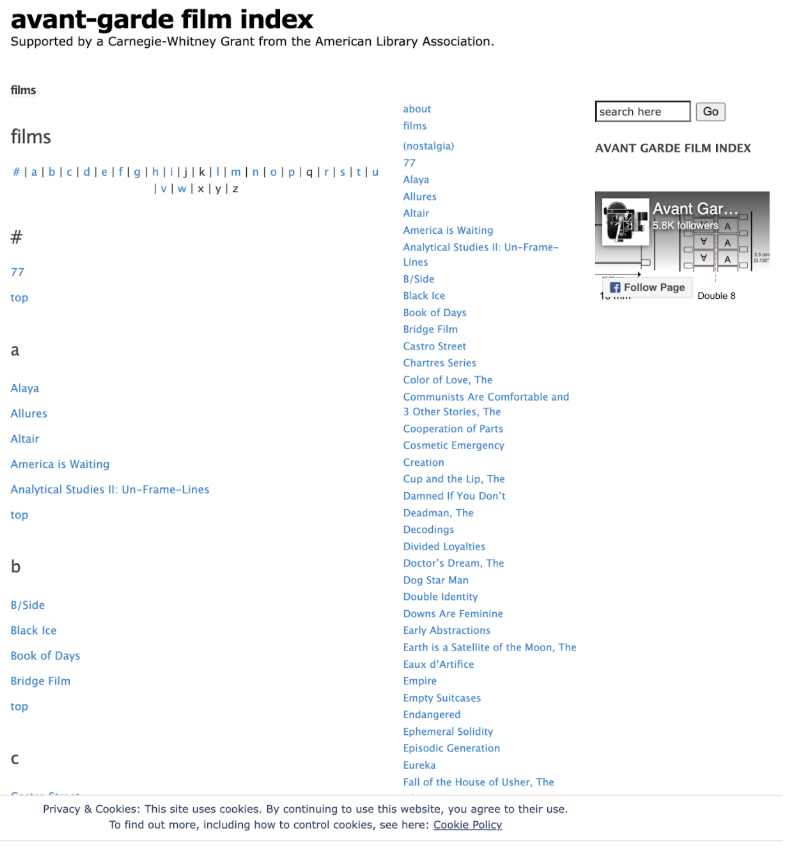
This early realization drew me to the Avant-Garde film index, pioneered by Liza Palmer, the review-section editor of Film International and co-editor-in-chief of Film Matters. In 2012, Palmer developed this treasure trove for the avant-garde researcher, including book lists, chapters, articles, web documents, and non-traditional publications “related to avant-garde film practice” (Avant Garde Film Index). I reached out to Palmer and asked if I could assist in building upon the important work she had achieved with the Index since its launch.
Problem
Palmer understood that the Avant Garde Index needed continual growth if it was to remain a relevant resource. Despite her tireless work, the Index faced a number of obstacles. Our team aimed to design a plan that would combat them.
First Problem: Since 2012, updates to the Index have been sporadic and unfocused. Our task was to decide which improvement areas were most critical, and implement a strategy that would foster long-term user engagement.
Second Problem: The Index struggled to appeal to a wider demographic beyond avant garde film researchers. We sought to make the site more accessible, by emphasizing avant garde film’s impact on popular culture and highlighting its interdisciplinary relevance.
Our team aimed to enhance Liza Palmer’s Avant Garde Film Index by expanding its scope, enhancing usability, providing up-to-date scholarship, and prioritizing long-term sustainability.
Methodology
Our approach manifested in a four-step methodology.
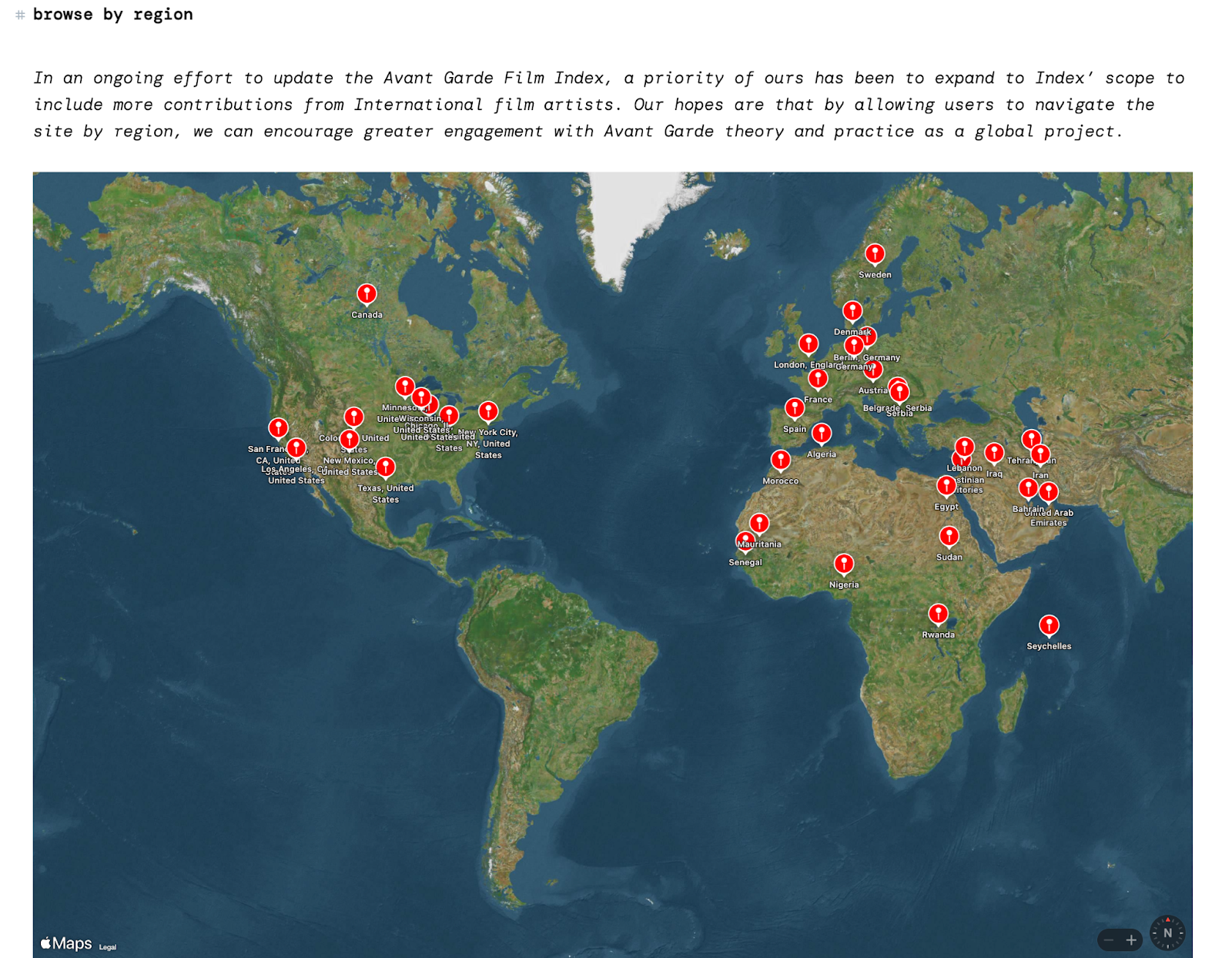
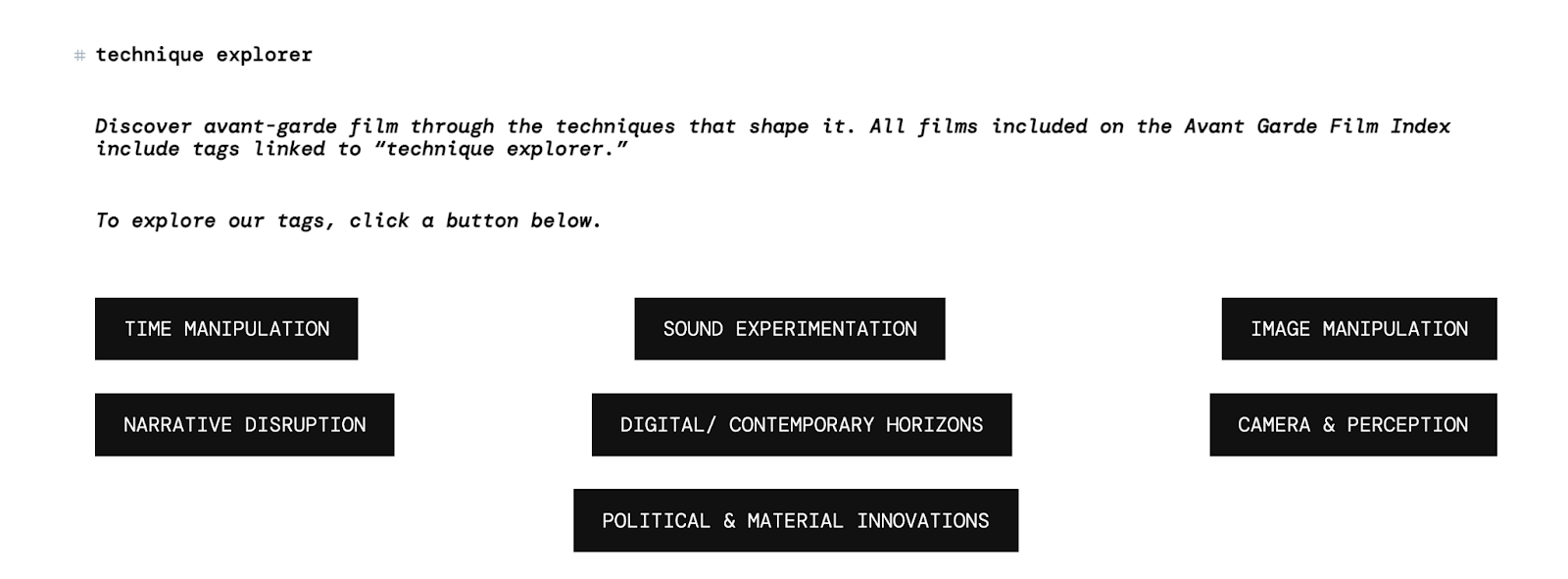
- We engaged in data cleaning of the initial sample – flagging dead links on a spreadsheet before removing them from the site. We developed a new criteria for evaluating international entries based off of Palmer’s established method (produced between 1905 and 2025, distinguished by external evaluative body, non-traditional distribution and exhibition forms). We designed strategies to improve search and filtering functionality, ensure WCAG compliance, and implement a geo-data visualization tool.
- We continued to add new entries to the site, documenting our progress on a collaborative spreadsheet, compiled 30 international entries with bibliographic references, implemented search & filtering improvements, WCAG compliance web design, and a data vis tool.
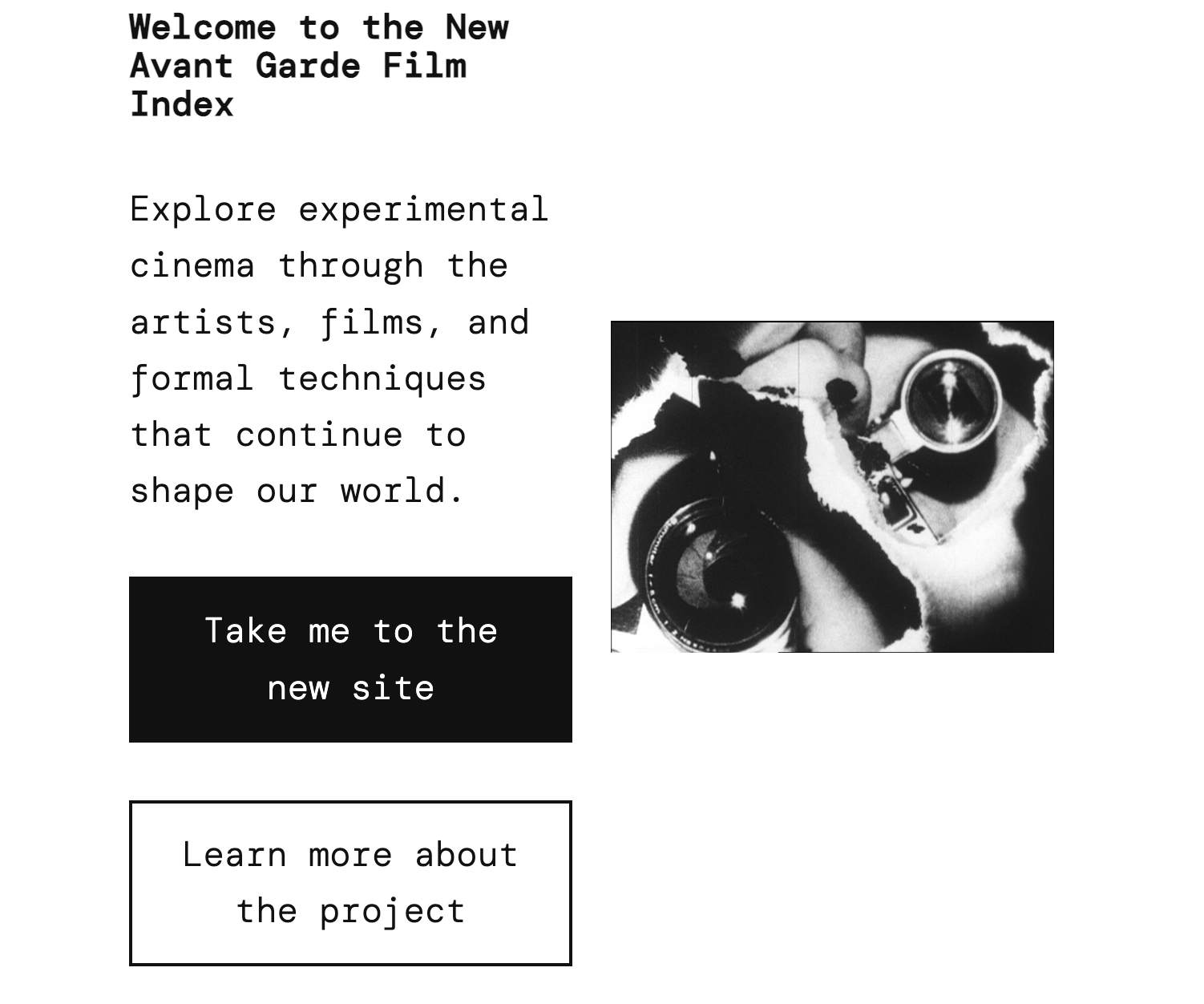
- We focused on providing interactive elements (video excerpts, interviews, archival materials, teaching resources). We worked to expand the Index’s reach, promoting the site through University networks, film organizations, and social media contacts.
- This term we focused on developing strategies for long-term maintenance, by partnering with University instructors, and transitioning to a collaborative, volunteer-driven model. We conclude this phase of the project today, with a launch event.
Connection To Coursework
The project was grounded in my own academic work. As an undergraduate student, majoring in Anthropology and minoring in global media studies, I was routinely engaged with numerous courses that asked that I approach film from an interdisciplinary perspective. I am indebted to the professors of these courses, without whom this project would not be possible. I would like to take a moment to highlight their influence.
- FTVM 601 – Theory and Method
As a junior at the University of Michigan, I was fortunate to enroll in Professor Daniel Herbert’s graduate level course FTVM 601, a survey of media theory and method spanning a handful of notable points in the discipline’s history, from formative theory to contemporary developments in feminist, queer, and race-centered understandings of film, television, and new media. Throughout this course, I was introduced to a handful of avant garde filmmakers who I would encounter repeatedly throughout my time updating the Index. FTVM 601 provided me with the historical and theoretical context necessary to fruitfully engage with “canonical” avant garde filmmakers like as Dziga Vertov, Maya Deren, and Stan Brakhage, as well as contemporary voices like Ufuoma Essi and Ryan Trecartin. Professor Herbert tasked our class with weekly essays designed to trace theoretical writings to contemporary film developments, an exercise that enabled me to draw more insightful connections between theory and practice, and more readily articulate the social, political, and formal significance of avant garde film. Additionally, the course provided me with a valuable method for navigating literature and scholarship pertaining to avant garde film developments through University of Michigan library resources. These skills were paramount for my aims as a researcher, and helped make an otherwise daunting slew of tasks a manageable process. FTVM 601 taught me that a firm grasp of avant garde film’s value is crucial for fostering a greater appreciation for the artform in others.
- FTVM 353 – Post New Wave
In my sophomore year, I enrolled in Professor Mark Kligerman’s “Post New Wave” course which I took in tandem with his previous “Origins of the New Wave” course. Kligerman’s encyclopedic knowledge of film alone made the course a joy to be a part of. I received some of my earliest opportunities to engage with film archives through 353’s quarter projects, which tasked students with designing research projects, research-informed course curriculum, and critical discourse analyses. Klingerman’s unorthodox approach to film analysis drew largely upon marginalized creative and scholarly voices. This along with his shrewd understanding of niche subcultures’ influence on popular film movements and trends challenged me to continually read both along and against the grain of archives. If Herbert’s Theory and Methods course was my deep dive into avant garde film, Klingerman’s Post New Wave course was my formal introduction to the riveting world of experimental cinema.
- HISTART 497 – The Avant Gardes & Their Legacy Today
Professor Daniel Herwitz’ course on the Avant Gardes and their legacy is one I wish I had taken sooner. Not only did this course provide me with a handful of reading materials related to avant garde history, theory, and practice, but it was taught by one of the discipline’s foremost authorities on the Avant Garde. Herwitz helped me situate experimental film developments in the context of Avant Garde film history more broadly, and understand the ways that avant garde film, music, poetry, photography, painting, sculpture and performance art developed in concert. Once Professor Herwitz was made aware of my project, he did not hesitate to reorganize the syllabus in order to incorporate greater reference to avant garde film art. I greatly appreciated Professor Herwitz’ courtesy in creating an environment which allowed me to regularly bring questions relevant to my honors project to the floor.
- INTRLGN 605 – Introduction to Primary Sources and Archives
Lecturer Mike Hawkins “Introduction to Primary Sources and Archives Course.” The course allowed me to reevaluate and restructure numerous aspects of my project. Hawkins made an effort to anchor our theoretical study of qualitative research methods in real-world application, an approach that had direct implications for my project. I was able to utilize class time and resources to visit physical and digital archives relevant to the study of avant garde film history such as Bentley Historical Library and New York Public Library Collections. I was equipped with the skills necessary to navigate parts of the University Library System I had previously never been acquainted with, such as Hatcher’s annotated bibliography and microfilm rooms, as well as the Special Collections floor. I had the opportunity to submit materials related to my honors project presentation to the class for recommendations, a format that allowed me to learn from a group of accomplished undergraduate and graduate students through low-stakes peer review.
Measurable Outcomes
Limitations & Recommendations
As this phase of our project comes to a close, we would like to acknowledge the limitations of our work. We have noted a handful of recommendations that we hope will structure future work.
Reach: The Index still stands to benefit from deeper connection to avant garde film archives, researchers, and artists. Future updates to the Index should be more closely associated with contemporary scholarship and practice. Researchers might consider attending film studies conferences, and registering for affiliated mailing lists.
Size: The Index currently includes only a handful of artists representative of the global avant garde film canon. Future additions might aim to emulate Palmer’s 100 artist sample size for each of our newly added regions (Europe, Japan, Africa/ Middle East, Latin America).
Engagement: Our team has made arrangements with professors within the University’s Film, Television, and Media department to organize student-led contributions to the Index in future semesters. Additionally, we have approached a handful of institutions Nation-wide with strong traditions in experimental, video art, and non-narrative work to expand our network of University partners. Future research teams could aim to incorporate students with a web design background to streamline frontend and backend coding processes.
My learning outcomes throughout this project have equipped me with the skills necessary to carry my work into future endeavors such as professional archival work and legal art advocacy.
Conclusion
The Avant Garde Film Index presents an exciting opportunity to introduce experimental film to students across the nation. The Index works to reframe Avant Garde Film art and history for a mainstream audience. Our hopes are that the project spreads greater awareness of the techniques, aesthetics, and philosophies behind the media we consume each day.
Thank you,
Solomon Trice
 avant-garde film index